News
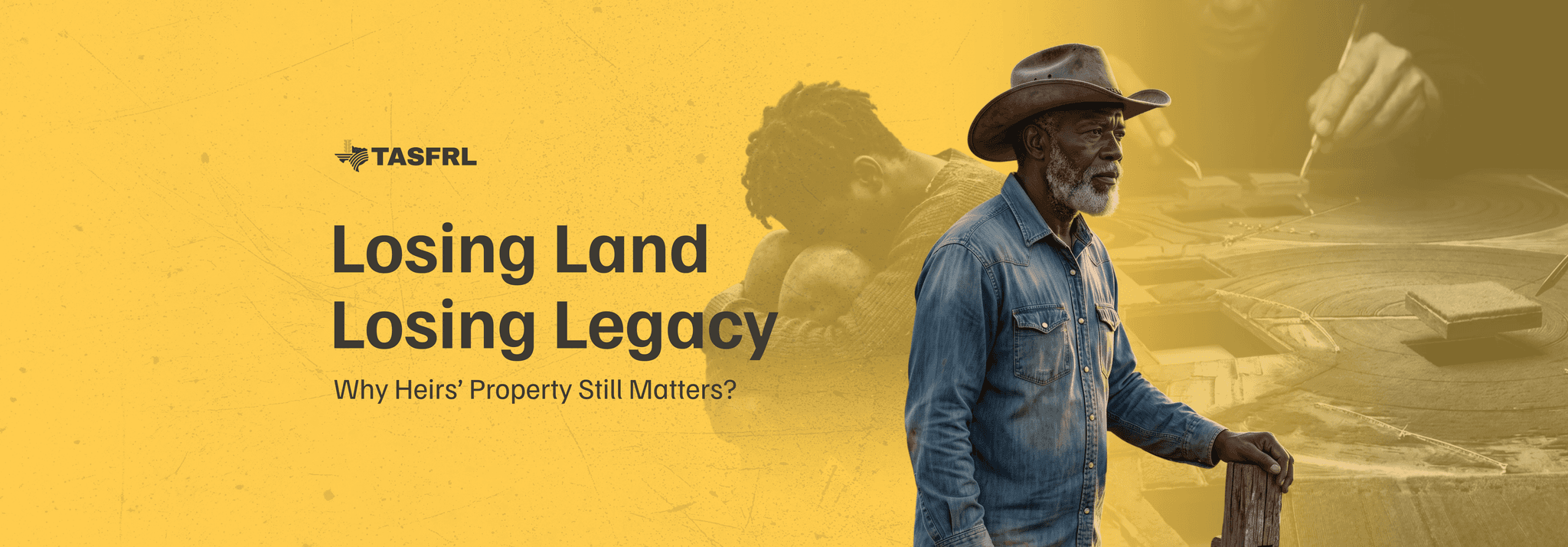
Losing Land, Losing Legacy: Why Heirs’ Property Still Matters
April 28, 2026
Author: TASFRL Team
For many families, land is more than property. It is memory, inheritance, stability, and a foundation for the future.
But across the United States, especially in rural Black communities, generations of family land have been lost through a legal and financial problem that many people still do not fully understand: heirs’ property.
Heirs’ property usually happens when land is passed down without a will or clear estate plan. Instead of one person holding a clear title, ownership is divided among multiple descendants as tenants in common. Some heirs may live on the land, pay taxes, and care for it every day. Others may live far away or may not even know they own a fractional interest in the property.
The USDA describes heirs’ property as land passed down informally from generation to generation, most often when landowners die without a will. According to USDA guidance, heirs’ property is land owned “in common” by all heirs, regardless of whether they live on the land, pay taxes, or have ever set foot on the land.
Source: USDA Farm Service Agency — What You Need to Know About Heirs’ Property
This ownership structure can make land vulnerable. When title is unclear, families may struggle to use the land as collateral, access loans, qualify for certain assistance programs, or make long-term improvements with confidence.
USDA Forest Service research connects heirs’ property to persistent poverty through three major factors: insecurity of ownership, reduced incentives to improve land, and the absence of collateral value.
Source: USDA Forest Service — Heirs’ Property and Persistent Poverty among African Americans in the South
How Heirs’ Property Can Lead to Land Loss
The danger is not only confusion within families. The larger risk comes when an outside buyer purchases one heir’s fractional interest and then goes to court to force a partition sale.
In a partition sale, the entire property can be sold, even when many family members do not want to sell. Families who live on the land may then be forced to compete at auction against investors or developers with far more money. In many cases, the family loses not only land value, but also history, identity, and a place that has held generations together.
The USDA has identified heirs’ property as a leading cause of Black involuntary land loss. USDA materials also note that one owner can force a court-ordered sale of the entire property so all descendants can “cash out.”
Source: USDA Farm Service Agency — What You Need to Know About Heirs’ Property
This issue is not theoretical. ProPublica’s reporting documented cases where Black families lost ancestral land through partition actions, including the story of Jessica Wiggins’ family in Bertie County, North Carolina. According to the reporting, Aldonia Farms purchased interests in a family’s 18-acre property and pursued a court-ordered sale, even though the remaining heirs still owned the majority share.
Source: ProPublica — Their Family Bought Land One Generation After Slavery
A Historic Pattern of Black Land Loss
The scale of Black land loss in America is enormous.
In 1910, Black farmers owned millions of acres of farmland across the United States. Over the 20th century, that land base declined dramatically.
The Lincoln Institute of Land Policy summarized research showing that Black Americans owned around 14 million acres of land by 1910, but by 2022 that number had dropped to about 1.1 million acres. The same source describes this as a roughly 90 percent decline, with a cumulative loss of about $326 billion in value.
Source: Lincoln Institute of Land Policy — Reclaiming Black-Owned Land
That history still shapes agriculture today. According to USDA’s 2022 Census of Agriculture, there were 46,738 producers who identified as Black, either alone or in combination with another race. They accounted for 1.4 percent of the country’s 3.4 million producers.
Source: USDA NASS — 2022 Census of Agriculture: Black Producers
These numbers matter because land ownership is not only about acreage. It affects who can build wealth, access credit, recover after disasters, participate in conservation programs, and pass opportunity to the next generation.
Why Unstable Ownership Affects Land Stewardship
Heirs’ property is often discussed as a legal issue, but it is also a land stewardship issue.
When ownership is unclear, families may be unable to make long-term decisions about conservation, forestry, agriculture, water management, infrastructure, or regenerative land use. They may hesitate to invest in improvements because they are not sure whether the land will remain in the family. They may also be excluded from programs that require clear documentation of ownership or control.
The result is a cycle: unstable ownership makes land harder to improve, and land that cannot be improved becomes more vulnerable to pressure, sale, neglect, or outside acquisition.
This is why land tenure and regenerative stewardship are deeply connected. You cannot build durable conservation systems on fragile ownership. If land rights are unstable, then farming, forestry, conservation, family wealth, and community continuity become unstable too.
A Path Toward Stability
The problem is serious, but it is not hopeless.
Across the country, families, advocates, legal organizations, land trusts, and public agencies are working to reduce the risks associated with heirs’ property.
One important reform is the Uniform Partition of Heirs Property Act. The law is designed to protect the right of one co-owner to sell their interest while giving other co-owners stronger due process before a forced sale. These protections can include notice, appraisal, and a right of first refusal.
Source: Land Trust Alliance — How the Uniform Partition of Heirs Property Act Works
Federal programs have also begun responding to the issue. USDA’s Heirs’ Property Relending Program is designed to help heirs’ property owners resolve land ownership and succession issues on agricultural land.
Source: USDA Farmers.gov — Heirs’ Property Relending Program
Still, policy alone is not enough. Families need education, early planning, access to trusted guidance, and community-based support before a crisis happens.
Why TASFRL’s Mission Matters
TASFRL exists because land is not just an asset. It is a foundation for identity, resilience, ecological health, and long-term economic opportunity.
Our mission is rooted in two connected principles:
Inclusive Roots means land stewardship must include communities that have historically been excluded from ownership, resources, decision-making, and opportunity.
Regenerative Futures means land systems should continuously improve ecological health, community stability, and long-term economic viability.
When land is stable, families can plan.
When families can plan, communities can invest.
When communities can invest, conservation and regeneration can grow.
Heirs’ property reminds us that land loss does not always happen suddenly. Sometimes it happens quietly, legally, and systematically. That is why awareness matters. Education is often the first step toward protection.
If your family is managing inherited land, facing uncertainty around ownership, or trying to understand the future of your property, now is the time to learn, organize, and seek trusted guidance.
Because protecting land is not only about preserving acres.
It is about protecting legacy.
Learn More from TASFRL
Learn more about TASFRL’s mission: About TASFRL
Explore TASFRL resources: Resources
Read more TASFRL news and updates: News
Contact TASFRL: Contact Us
View land management support options: Land Management Request
External References
- USDA FSA — Heirs’ Property: What You Need to Know https://www.fsa.usda.gov/sites/default/files/documents/whatuneedtoknow_heirprop.pdf
- USDA Forest Service — Heirs’ Property and Persistent Poverty https://research.fs.usda.gov/treesearch/62088
- ProPublica — Their Family Bought Land One Generation After Slavery. The Reels Brothers Spent Eight Years in Jail for Refusing to Leave It. https://features.propublica.org/black-land-loss/heirs-property-rights-why-black-families-lose-land-south/
- Lincoln Institute of Land Policy — Understanding Heirs’ Property https://www.lincolninst.edu/publications/land-lines-magazine/articles/understanding-heirs-property/
- USDA NASS — 2022 Census of Agriculture: Black Producers https://www.nass.usda.gov/Publications/Highlights/2024/Census22_HL_BlackProducers.pdf
- USDA Farmers.gov — Heirs’ Property Relending Program https://www.farmers.gov/working-with-us/heirs-property-eligibility/relending
- Land Trust Alliance — Uniform Partition of Heirs Property Act: How It Works https://landtrustalliance.org/resources/heirs-property-toolkit/uniform-partition-of-heirs-property-act/how-it-works
- Farm Aid — Heirs’ Property and the Decline of Black-Owned Farmland https://www.farmaid.org/blog/heirs-property-90-percent-decline-black-owned-farmland/
Other News
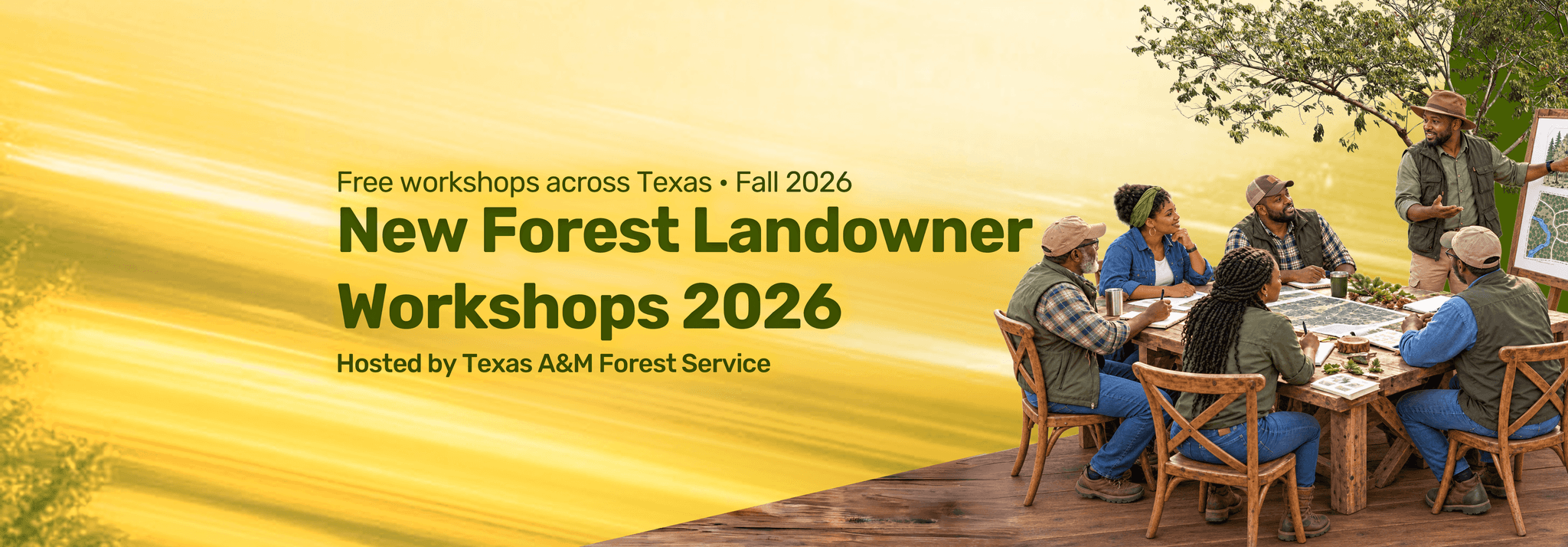
Free New Forest Landowner Workshops Coming to Texas This Fall
A starting point for caring for your forest Forest ownership comes with decisions about the land you have, the goals you want to pursue, and the support you may need along the way. These workshops focus on a new forest landowner's “to-do” list, offering a practical starting point for learning about your property and planning its future. According to the workshop flyer, participants will explore: Learning about their forest. Defining their ownership goals. Evaluating forest health. Understanding financial considerations. Beginning the process of developing a management plan. The workshops will also help participants locate natural resource professionals who can support informed management decisions. Building that support network can help landowners identify whom to contact as they begin working through questions about their forest. If you are still considering forest ownership, these topics offer an introduction to the decisions involved. If you have already acquired land, they provide a starting point for thinking about what you want to achieve and how a management plan could guide your next steps. Workshop dates and locations Choose the workshop location that works for you: Lufkin: October 20, 2026 Overton: October 23, 2026 Dallas: October 26, 2026 Houston: November 2, 2026 Conroe: November 13, 2026 The dates and city names above follow the organizer's flyer. Check the official registration page for current venue details and registration information before making travel plans. Register with the organizer Visit the official registration page to find a workshop near you and sign up directly with the organizer. Register with Texas A&M Forest Service You can also view the original workshop flyer for an overview of the series. Know someone who has recently acquired forestland or is considering it? Share this article so they can review the workshop dates and find the organizer's registration page.

TASFRL Team
Oct 25, 2026

Preserving Land for Texas Landowners: Join Us for a Community Listening Session
For many families in Texas, land represents more than acreage. It can represent family history, stability, independence, opportunity, and something to pass from one generation to the next. But maintaining ownership of family land can also come with difficult questions and challenges, from unclear titles and heirs’ property concerns to rising property costs, development pressure, and limited access to legal, financial, or technical support. That is why the Texas AgriForestry Small Farmers, Ranchers, and Landowners (TASFRL) and HARC (Houston Advanced Research Center) are inviting Black landowners and families across Texas to participate in a series of Community Listening Sessions. The purpose is simple: to listen. Your Experience Can Help Shape What Comes Next Every landowner’s situation is different. Some families have cared for the same property for generations. Others may be trying to understand how land was passed down, clarify ownership, plan for the future, or determine how their property can continue supporting their family. These listening sessions are designed to hear directly from landowners about questions such as: What does owning or managing your land mean to you and your family? What challenges have you experienced while trying to keep or manage your property? Where do you currently go when you need legal, financial, or technical information? What kinds of resources or support would make maintaining land ownership easier? What would you like to learn more about to better manage, protect, or generate income from your land? There are no right or wrong answers. The goal is to better understand what landowners are experiencing and what kinds of support may be most useful to families and communities across Texas. Why These Conversations Matter Land ownership has long played an important role in family stability and generational wealth. At the same time, Black landowners have faced challenges that can make retaining family property difficult. These may include heirs’ property and unclear titles, forced partition sales, increasing property costs, development pressure, and limited access to trusted legal or financial resources. HARC's broader land-retention project is focused on gathering community input and building relationships that can help identify practical strategies for supporting landowners. Listening first is an important part of that process. The experiences shared during these sessions can help HARC, TASFRL, and collaborating organizations better understand where resources are needed and how future education, technical assistance, legal support, financial guidance, and other services can be designed around real community needs. What to Expect During the Listening Session Each session is expected to last approximately 90 minutes and will provide an informal environment for conversation. The session will include: A welcome and introduction A brief overview of the project and its goals Guided discussion about land ownership experiences and challenges Opportunities for participants to share what kinds of support they need A brief question-and-answer period For in-person sessions, light refreshments may also be provided. The primary purpose of the event is to listen and gather information. TASFRL may share existing resources with participants, but the listening session is not intended to provide individualized legal, financial, or technical consultation. Who Should Participate? The Community Listening Sessions are intended primarily for: Black landowners and family members of Black landowners in Texas. Whether your family has owned land for generations, you are currently helping manage inherited property, or you are thinking about how to protect land for the next generation, your experience can contribute to this conversation. You do not need to be an expert in property law, agriculture, forestry, finance, or estate planning. You only need to bring your experience and perspective. Upcoming Community Listening Sessions TASFRL and HARC are planning three opportunities for Texas landowners and families to participate: Listening Session #1 (2).jpg Virtual Community Listening Session #1 📅 Thursday, August 27, 2026 🕙 6:00 PM CT ⏱️ 60 Minutes 💻 Virtual Event WhatsApp Image 2026-08-30 at 22.35.42.jpeg Virtual Community Listening Session #2 📅 Thursday, September 10, 2026 🕙 6:00 PM CT ⏱️ 60 Minutes 💻 Virtual Event WhatsApp Image 2026-08-30 at 22.35.43.jpeg In-Person Community Listening Session #3 📅 Saturday, September 19, 2026 🕙 10:00 AM CT ⏱️ 120 Minutes 📍 Courtyard By Marriott Tyler, 7424 South Broadway Avenue, Tyler, TX 75703, Smith County 🍽️ Lunch provided Participants can choose the session that works best for their schedule. Building Solutions With Landowners, Not Just for Landowners The larger project, led by HARC and funded by The Cynthia and George Mitchell Foundation, seeks to better understand the challenges contributing to land loss and identify strategies that can help Black landowners maintain ownership and build long-term wealth. Potential areas of support may include greater access to legal resources, information about funding opportunities, assistance related to heirs’ property and estate planning, strategies for generating income from land, and resources for navigating development pressures. But determining what support is actually useful starts with hearing from the people directly managing and protecting the land. That is the purpose of these conversations. Your Land. Your Experience. Your Voice Matters. Keeping family land requires more than hard work. It can also require information, planning, trusted resources, and organizations that understand what landowners are actually facing. HARC and TASFRL want to hear directly from Texas landowners before determining what comes next. If you or your family owns or manages land in Texas, we invite you to join a Community Listening Session and share your experience. Your perspective can help shape stronger resources, better planning, and practical support for landowners and families across Texas. Register for a Community Listening Session Visit the tasfrl.org/event to view session details and register for an upcoming session. Your land. Your experience. Your voice matters. Inclusive Roots. Regenerative Futures.
TASFRL Team
Aug 18, 2026
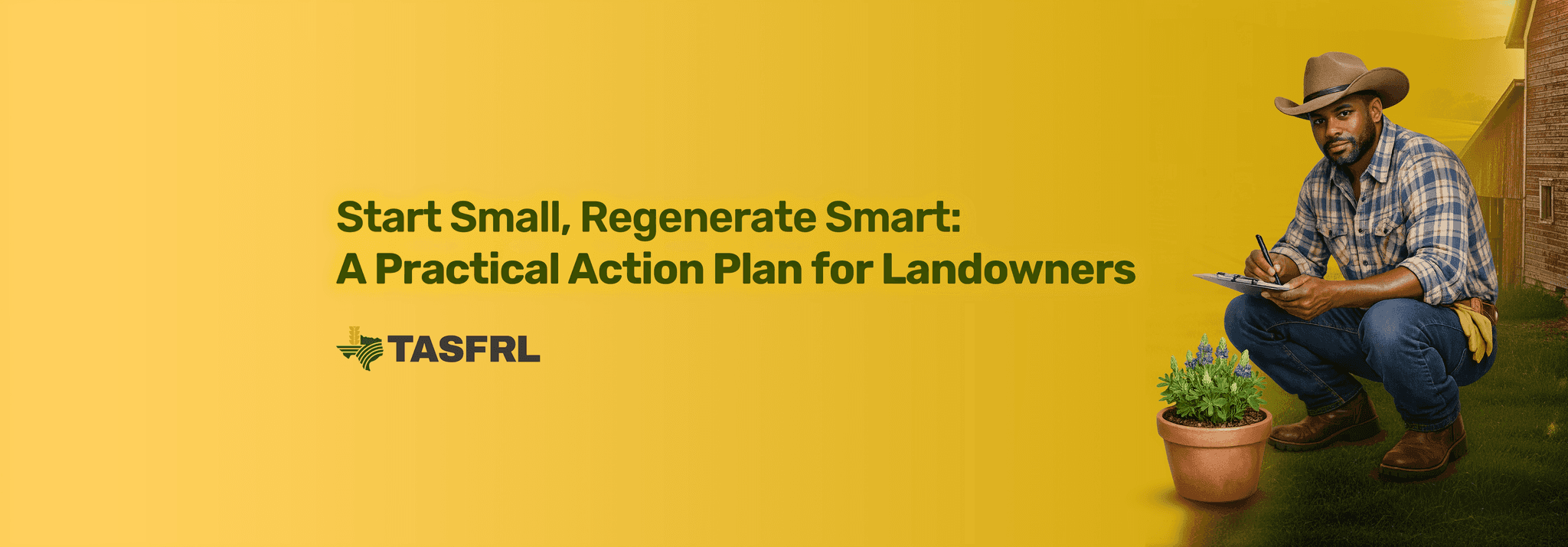
Start Small, Regenerate Smart: A Practical Action Plan for Landowners
Regenerative land management can feel overwhelming when it is viewed as a complete transformation of an entire farm, ranch, forest, or rural property. Landowners may understand the value of healthier soil, improved water movement, stronger vegetation, and more resilient land. However, the question that often follows is simple: Where should I begin? The answer does not have to involve changing the entire property at once. Regeneration can begin with one clear objective, one manageable area, and one practical improvement. Starting small allows landowners to observe how the land responds, manage costs and risks, and make better-informed decisions before expanding a practice across a larger area. Here is a practical five-step action plan for moving from land readiness to meaningful action. 1. Set a Clear Goal for Your Land Before selecting a practice, identify what you want to improve. Regeneration can mean different things depending on the property, its current condition, and how the land is being used. A farmer, rancher, forest landowner, or small-acreage property owner may each have different priorities. Your initial goal might be to: Reduce soil erosion Increase ground cover Improve water infiltration Restore an overused pasture Protect a creek, pond, or drainage area Improve soil structure Support more diverse vegetation Strengthen forest or woodland health Improve livestock distribution Increase the land’s resilience during drought or heavy rainfall Avoid trying to address every concern at the same time. Select one primary goal and, when appropriate, one supporting goal. For example, a landowner may begin with the primary goal of reducing erosion while also working to increase vegetation along a vulnerable slope. A focused goal makes it easier to select appropriate practices and determine whether those practices are producing meaningful results. 2. Record the Land’s Current Condition Before making changes, document what the land looks like today. This creates a baseline—a starting point that can later be compared with future conditions. Without a baseline, it can be difficult to determine whether a new practice is helping, having little effect, or creating an unexpected problem. Walk through the property and observe: Areas of bare or compacted soil Signs of erosion Locations where water collects or moves rapidly Areas with weak or uneven vegetation Pastures that recover slowly Streambanks or drainage areas that appear unstable Places where livestock frequently gather Areas with declining tree or plant health Changes in soil moisture across the property Invasive or undesirable vegetation Take photographs from consistent locations and angles. Mark important areas on a property map or create simple notes on a phone, tablet, or notebook. The documentation does not need to be complicated. A basic record may include: The date Recent weather conditions General soil condition Vegetation coverage Visible erosion Water movement Livestock use Photographs of the area Returning to the same observation points over time can reveal changes that may not be noticeable from day to day. 3. Choose a Manageable Pilot Area Instead of applying a new practice across the entire property, select a smaller area where the practice can be tested. A pilot area could include: One pasture section A portion of a grazing paddock A field edge A frequently eroded slope A livestock watering location A woodland boundary A stream or drainage buffer A compacted area near a gate A small section of degraded land The pilot area should be large enough to provide useful observations but small enough to manage without placing unnecessary pressure on time, labor, or finances. Starting with a defined area offers several advantages. It allows the landowner to: Test a practice before expanding it Compare treated and untreated areas Identify implementation challenges Estimate labor and material needs Monitor results more closely Make adjustments with less risk For example, a rancher interested in changing grazing management might begin with one pasture rather than redesigning the entire grazing system immediately. A forest landowner working to protect soil and water may begin with one drainage area or forest edge where runoff is already visible. The purpose of the pilot is not to create instant perfection. It is to learn how a specific part of the property responds to a carefully selected action. 4. Begin with One or Two Practical Improvements Once the goal and pilot area have been identified, select a limited number of practices that directly address the problem. Depending on the property, practical first steps may include: Maintain More Ground Cover Bare soil is more vulnerable to erosion, moisture loss, temperature extremes, and surface crusting. Maintaining living plants, plant residue, or other appropriate protective cover can help shield the soil. Reduce Unnecessary Soil Disturbance Frequent or intensive disturbance can disrupt soil structure and leave the surface exposed. Where appropriate, reducing disturbance may help protect soil aggregates, roots, and biological activity. Adjust Grazing and Recovery Periods Land that is grazed repeatedly without adequate recovery may lose plant vigor and ground coverage. Adjusting livestock timing, density, or movement can give vegetation more time to recover. Protect Waterways and Drainage Areas Vegetative buffers around streams, ponds, ditches, and drainage pathways can slow runoff, capture sediment, and protect vulnerable banks. Improve Water Distribution Livestock movement and grazing pressure are often influenced by the location of water. Reviewing watering locations may help reduce repeated pressure in certain areas. Allow Degraded Areas to Rest Some areas may need temporary protection from traffic, grazing, or equipment before vegetation and soil conditions can begin to recover. Increase Plant Diversity Where suitable, increasing plant diversity may improve seasonal ground cover, root structure, habitat, and resilience. Plant selection should be appropriate for the local soil, climate, and land-use goals. The best first practice is not necessarily the most expensive or technically complex. It is the practice that addresses a clearly observed problem and can be implemented consistently. Landowners should also consider local conditions before making significant changes. Soil type, rainfall patterns, slope, vegetation, livestock needs, forestry objectives, and available resources can all influence whether a practice is appropriate. 5. Monitor the Results and Adjust the Plan Regeneration is not a one-time project. It is an ongoing process of observation, learning, and adjustment. Return to the pilot area regularly and compare its condition with the original baseline. Depending on the goal, monitor indicators such as: Percentage of ground covered by vegetation or residue Changes in bare soil Plant recovery and vigor Water infiltration after rainfall Standing water or runoff Soil moisture Visible erosion Forage availability Plant diversity Livestock distribution Tree regeneration or woodland condition Changes may occur gradually. Some results may become visible within a growing season, while others may require longer observation. Stability of streambanks and drainage areas Weather must also be considered. Drought, prolonged rainfall, storms, and seasonal temperature changes can affect outcomes. A single dry or wet period may not provide enough information to evaluate the long-term value of a practice. Ask practical questions during the monitoring process: Is ground cover improving? Is water moving differently across the area? Are plants recovering more effectively? Has erosion decreased? Is the practice manageable with the available labor and budget? Did the land respond as expected? What should be adjusted before the next season? When a practice is producing positive and manageable results, it can be expanded gradually to another section of the property. When it is not working as intended, the landowner can modify the approach without having committed the entire property to the same strategy. What Does Early Progress Look Like? Success does not always appear as a dramatic transformation. Early indicators of progress may include: Less exposed soil Slower surface runoff More consistent vegetation Improved plant recovery Fewer visibly eroded areas Better livestock distribution Increased soil moisture after rainfall Greater confidence in land-management decisions These smaller improvements can provide useful evidence that the land is moving in a healthier direction. The purpose of starting small is not to limit the landowner’s vision. It is to create a practical pathway for reaching larger goals. Build the Plan Around the Land Regenerative land management is most effective when it is based on the actual condition of the property rather than a single practice or trend. What works well on one farm, ranch, or forest property may need to be adapted for another. Each landowner must consider the land’s history, current use, ecological condition, operational needs, and long-term goals. A thoughtful action plan should remain flexible. Observe the land. Document what is happening. Test one practical change. Measure the response. Then decide what comes next. Start with the Next Manageable Step Landowners do not need to have every answer before beginning. A practical regeneration plan can start with: One clear goal One documented baseline One manageable pilot area One or two appropriate practices One consistent monitoring process Over time, these small and informed actions can support healthier soil, stronger vegetation, improved water management, and more resilient working lands. Start small. Learn from the land. Regenerate smart. Suggested Closing CTA TASFRL encourages farmers, ranchers, forest landowners, and rural property owners to approach land stewardship through informed observation, practical planning, and long-term care. Explore more land-management resources and educational information from TASFRL at tasfrl.org References U.S. Department of Agriculture, Natural Resources Conservation Service. (n.d.). Soil He. USDA Natural Resour U.S. Department of Agriculture, Natural Resources Conservation Service. (n.d.). Soil. USDA Natural U.S. Department of Agriculture, Natural Resources Conservation Service. (n.d.). Conservation P. USDA Natural Schreefel, L., Schulte, R. P. O., de Boer, I. J. M., Schrijver, A. P., & van Zanten, H. H. E. (2020). Regenerative agriculture—The soil is the base. Global F, 1004https://doi.org/10.1016/ Bünemann, E. K., Bongiorno, G., Bai, Z., Creamer, R. E., De Deyn, G. B., de Goede, R., Fleskens, L., Geissen, V., Kuyper, T. W., Mäder, P., Pulleman, M., Sukkel, W., van Groenigen, J. W., & Brussaard, L. (2018). Soil quality—A critical review. Soil B,https://doi.or Pellant, M., Shaver, P. L., Pyke, D. A., Herrick, J. E., Lepak, N., Riegel, G., Kachergis, E., Newingham, B. A., Toledo, D., & Busby, F. E. (2020). Interpreting Indicators of Rangeland Health, Version 5. Technic
TASFRL Team
Aug 9, 2026